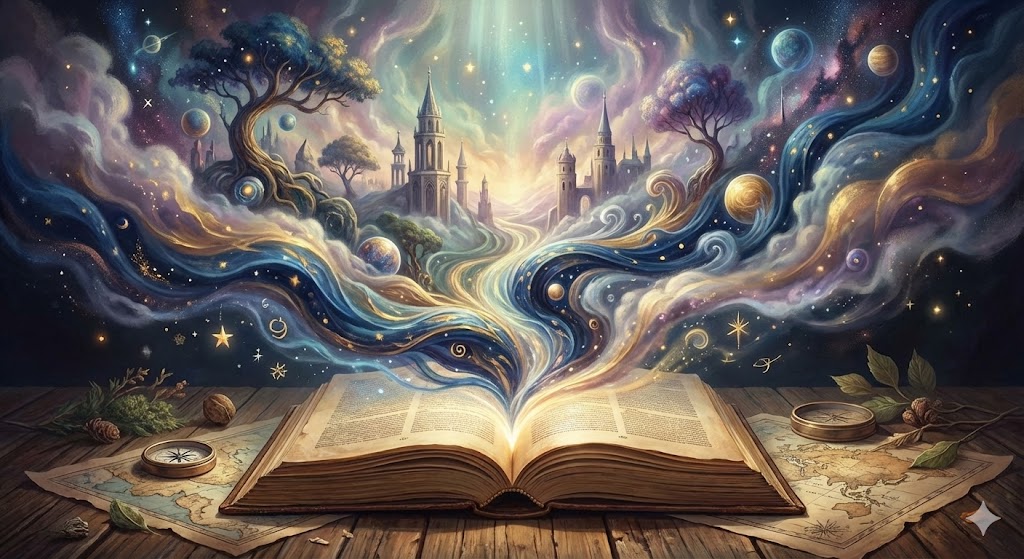
When Words Are Not Enough: How Visual Art Shapes Storytelling
Introduction: Beyond the Written Word As writers, we are obsessed with words. We chase the perfect sentence, the exact adjective, the rhythm of a paragraph. But sometimes, the human experience—especially the turbulent emotional landscape of adolescence—is too vast for words alone.
Sometimes, you need a picture to tell the truth.
In writing Eureka and the Magical Trio, I found that standard descriptions weren't enough to capture the magic of Eureka’s journey or the depth of her Lithuanian heritage. I needed a different language entirely. I found that language in the visionary art of M.K. Čiurlionis.
The Painter of Music Mikalojus Konstantinas Čiurlionis was not just a Lithuanian painter; he was also a composer. His genius lay in his ability to "paint music" and "compose colors." His work doesn't look like reality; it looks like a dream state, full of cosmic symbolism, towering structures, and flowing energy.
For a YA novel dealing with identity and magic, his art is the perfect muse. When a character in my story experiences something profound—a connection to their ancestors, or a burst of magical realization—I don't just tell the reader how they feel. I try to describe the scene as if Čiurlionis were painting it. The world doesn't just get brighter; it dissolves into sound and color.

Art as a Portal in YA Fiction In Young Adult literature, art often serves as more than just background decoration. It is a portal.
For Eureka, engaging with the artistic heritage of her culture isn't a passive history lesson. It is an active, magical doorway. When she looks at a mandala or engages with the kaleidoscope, she isn't just seeing pretty patterns; she is accessing a ancestral memory bank.
Art allows young protagonists to access parts of themselves that logic and everyday language have sealed off. It provides a safe space to explore complex emotions like grief, displacement, and hope.
Conclusion: Finding Your Own Canvas Writing Eureka taught me that storytelling is a multisensory experience. We shouldn't limit ourselves to just one mode of expression.